Datta Parikrama
Shri Datta Parikrama is a sacred pilgrimage that enables devotees to visit important Datta pilgrimage centers, receive the spiritual merit of those holy places, and gain the grace and blessings of Shri Dattatreya. Along with Shri Dattatreya, his various incarnations, his disciples, and saints of the Datta tradition share a unique quality—they love their devotees unconditionally, give them strength, help them overcome difficulties, and guide them forward on the path of devotion. This is a deeply held belief among devotees.
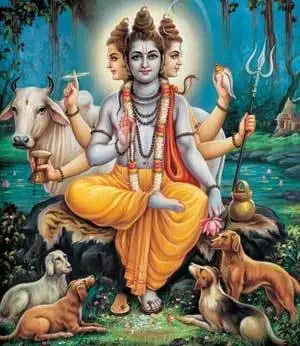
Shri Dattatreya accepted 24 Gurus and learned different virtues from each of them. To become the Jagadguru (Universal Teacher), he undertook intense penance, spiritual practice, and pilgrimages. Shri Dattatreya is a divine being whose existence is eternal. He is all-encompassing and inclusive of everyone. His harmonious outlook helps maintain social, natural, mental, emotional, and spiritual balance. His divine presence is deeply experiential and transformative.
The twenty-four Gurus of Dattatreya symbolize the 24 energy centers within the human body. Every human body is considered a miniature version of the universe—“As is the microcosm, so is the macrocosm.” Through spiritual practice and worship, these energy centers gradually awaken. As a result, a person’s inner strength increases, they receive the support of the five elements of nature, align with the universal cycle, improve their efficiency, and develop a more positive outlook on life. Overall, the individual’s life becomes mature and enriched. As the gap between conscious and subconscious awareness reduces, the person begins to move toward completeness. Shri Datta Parikrama is an effort to awaken these inner energy centers.
Devotees wish to visit every Shri Datta pilgrimage site in the country, but it is difficult to do so individually. There are hundreds of Datta pilgrimage centers across India, and almost every village has a Datta temple. However, some centers are especially prominent. Shri Datta Parikrama connects 24 major Datta pilgrimage sites across four states—Maharashtra, Karnataka, Andhra Pradesh, and Gujarat—into one sacred journey.
The Datta Parikrama begins in Pune at Shri Shankar Maharaj Samadhi Mandir. The sequence of pilgrimage sites is as follows:
Shri Shankar Maharaj Samadhi Mandir, Pune
Audumbar
Basavakalyan
Nrusinhawadi
Amarapur
Paijarwadi
Kudutri
Mangav
Balekundri
Murgod
Kuruvapur
Manthangudi
Ladachi Chincholi
Kadaganchi
Maniknagar (Humnabad)
Gangapur
Akkalkot
Latur
Mahur
Karanja
Bhalod
Nareshwar
Tilakwada
Garudeshwar
Among these, 12 sites are in Maharashtra, 2 in Andhra Pradesh, 6 in Karnataka, and 4 in Gujarat. The total journey covers approximately 3,600 kilometers and can be completed by bus or car. During the Datta Parikrama, accommodation and food facilities are available at each pilgrimage site.
The pilgrimage sites are associated with Shri Dattatreya and his incarnations. The uniqueness of the Datta tradition lies in the fact that the work and legacy of Datta incarnations continue uninterrupted through various enlightened saints.
During the Datta Parikrama, devotees receive darshan of Datta incarnations and saints blessed by Datta’s grace, including:
Shripad Shrivallabh
Shri Nrusimha Saraswati Swami Maharaj
Shri Swami Samarth Maharaj
Shri Manikprabhu Maharaj
Vasudevanand Saraswati Swami Maharaj
Pant Maharaj of Balekundri
Chidambar Dikshit Swami Maharaj
Dikshit Swami Maharaj
Gulvani Maharaj
Chile Maharaj
Shridhar Swami
Shri Sayandev
Shri Sadanand Datta Maharaj
Rangavadhut Maharaj
Shri Shankar Maharaj
Though these pilgrimage sites are spread across different regions and states, they are united by the common thread of Datta devotion. Languages, customs, cultures, food habits, geography, lifestyles, and social systems vary from place to place. Yet, all these sites are bound together by a single spiritual principle. Datta Parikrama brings together people from all sections of society.
The saying “Whoever we meet is God” reflects the belief that God exists within every person—Datta resides in everyone. Every individual should be able to say, “Dattoham”—I am Datta. This means that goodness, divinity, and purity exist within every person, and it is each individual’s responsibility to nurture and express these qualities.
Through Datta Parikrama, a seeker’s life becomes illuminated and refined. The primary reason is direct spiritual experience. By staying at each Datta pilgrimage site and deeply absorbing its spiritual atmosphere, the seeker awakens their inner energy centers. With the help of society, cooperation of many people, and harmonious effort, collective spiritual work is accomplished. Visiting these holy places brings peace to the mind and creates inner joy.
During Datta Parikrama, devotees spend a significant amount of time near the Krishna River. Shri Dattatreya has a deep affinity for rivers, just as he does for mountains. Shripad Shrivallabh and Shri Nrusimha Saraswati spent much of their lives near the Krishna River. Along with Krishna, devotees also experience the presence of the Bhima and Narmada rivers. At Gangapur, there is the confluence of the Bhima and Amarja rivers, and the Bhima ultimately merges into the Krishna. In Gujarat, devotees witness the magnificent sight of the Narmada River. Additionally, the Godavari River and several other small and large rivers are encountered during the pilgrimage.
The journey offers breathtaking views of nature. Along with the Narmada Parikrama and Kardali Van Parikrama, Shri Datta Parikrama represents a unique spiritual dimension of pilgrimage traditions. A special feature of the Narmada and Kardali Van Parikramas is the physical hardship and walking involved, which also brings great joy. Shri Datta Parikrama, however, can be done by vehicle or bus, making it comparatively easier. Moreover, facilities and amenities are available at the various Datta pilgrimage centers.
